
The origins of sr4 Partners are rooted in a 2009 culture initiative that brought together an ad hoc team of professionals from many disciplines, including experiential learning, appreciative inquiry, organizational development, program design, data analysis, and communication strategy. The team developed a plan to invite every member of a nationwide organization to think of a time when they felt like they were performing at their very best, and then attend a meeting to share their stories.
As they gathered in small groups around the country, they were asked to listen to each other’s stories in a specific way: to write down what it was about the organization itself that enabled an individual member to feel like they were performing as the best version of themselves. So the real work was not in “the telling,” but in “the listening.”
Attributes of the organization that helped people to perform at the peak of their abilities were recorded, categorized, and condensed by a core team of employees. Through this process, 5,000 stories…collected over 5 months…were winnowed down to 5 words…that would serve as the building blocks of the organization’s culture going forward.
However, there was also an unexpected outcome: that ad hoc team did not want to disband! And so, in the spirit of self-determination, the team reorganized itself as a freestanding consultancy, doing business as sr4 Partners. Thriving Cultures remains as a core focus of the firm, in addition to Healthy Leaders, Cohesive Teams and Inclusive Change.
The technique of “appreciative story-listening” that we pioneered in that first culture initiative remains as one of our favorite activities. But our culture work today extends far beyond the key words that you hang on the wall.
Today we approach all culture initiatives with five core beliefs:
- Culture drives your business performance.
- Culture either enables your strategy, or inhibits it.
- Culture is the responsibility of everyone in your organization.
- Culture is a quantifiable attribute that you can measure, track and correlate with your performance against your business goals.
- Your culture can change.
We have tools and techniques that we can use to help you nudge your culture in the direction you want it to go. And if you need to make big changes, we have a comprehensive five-step approach we call Culture Kaizen. The steps are:
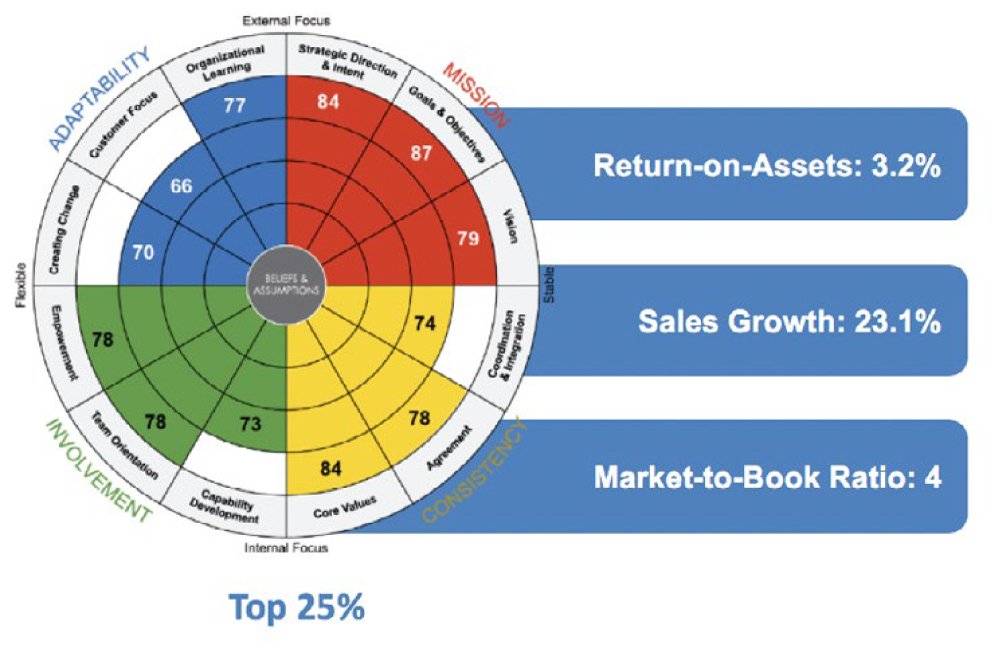
- Survey. We use a diagnostic tool known as the Denison Organizational Culture Survey. It measures four key cultural traits and 12 related management practices. With the results of this survey, links can be drawn between culture and sales growth, ROE, ROI, customer satisfaction, innovation, employee satisfaction, quality and more.
- Share. We review results of the survey in small interactive sessions – ideally, 25 or fewer participants. Nothing is held back – total transparency of strengths and weaknesses, including how your organization compares with 1,000 others worldwide.
- Invite. We actively solicit everyone’s participation in changing the culture. We want to start a cultural conversation that becomes an engrained organizational habit, and engages both hearts and minds.
- Train. We constantly identify those with the most enthusiasm, and then we support their development and leadership. We introduce guidelines and encourage expansion of the conversation over time. We equip natural cultural leaders with a familiar and easy-to-learn methodology.
- Improve. We set boundaries that establish “the box” for “what success looks like.” We grow sponsorship and coaching over time. And we continue to encourage successful implementation of culture change initiatives.
In Practice
We employed Culture Kaizen over a five-year period with a European organization comprised of some 1,100 members in 11 countries. We started by enlisting the company’s executives in the Culture Kaizen process. We then developed local leaders as teachers of the process, and from there we worked to involve everyone at all levels. Finally, we worked to transfer ownership of positive culture change from the initiators at the center to the implementors throughout the organization.
As we continued to administer the diagnostic survey throughout the process, results improved in every cultural category. Significantly, as cultural metrics improved, so did revenues, operating expenses and operating earnings.
Something You Can Do, Now
Consider these two charts courtesy of the Denison Organizational Culture Survey. Both charts display data from 130 publicly traded companies that have taken the survey. The first chart, with all the results clustered in the lowest quartile, represents the bottom 25 percent of participants, along with these companies’ composite return-on-assets, sales growth and market-to-book ratio.
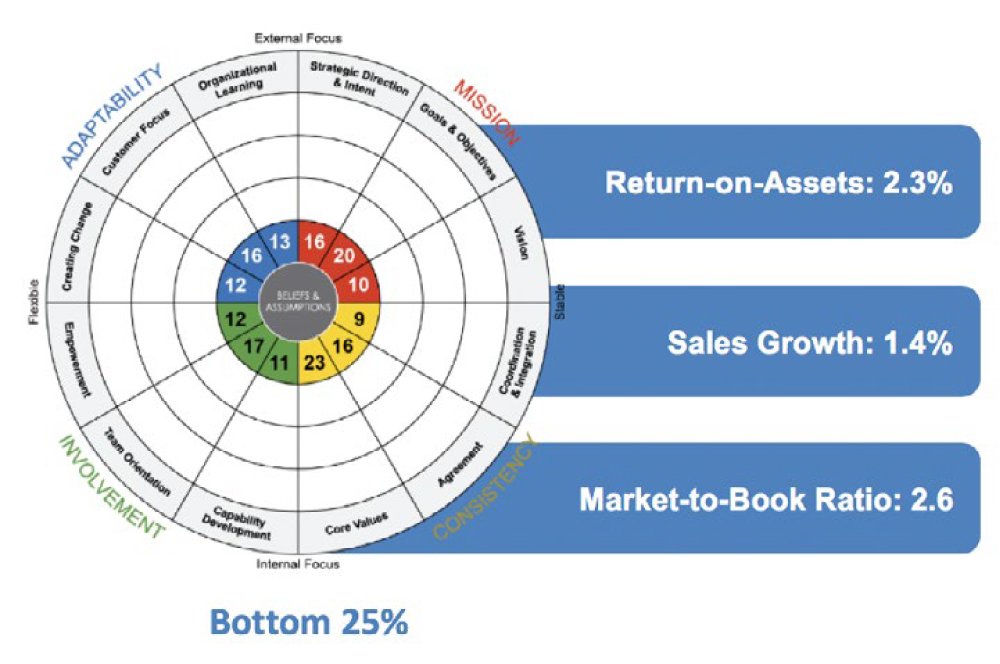
The second chart, with all the results extending into the third and fourth quartiles, represents the top 25 percent of participants. The data points identify the current state for four key cultural traits and 12 related management practices. And that current state correlates directly with the three performance metrics of ROA, sales growth and market-to-book ratio: higher scores on the culture survey are consistent with better numbers in three generally accepted measures of business performance.
In which quartile do you think your organization would most likely land, in these four cultural traits:
Mission. Do you know where you’re going? Do you have clear goals and a strategy to reach them?
Adaptability. Are you listening to the marketplace, to customers? How well do you identify and respond to their changing needs?
Involvement. How well do you empower employees, build teams, and develop the human capability in your organization?
Consistency. Have you established coordinated systems that enable you to build agreement based on your core values?